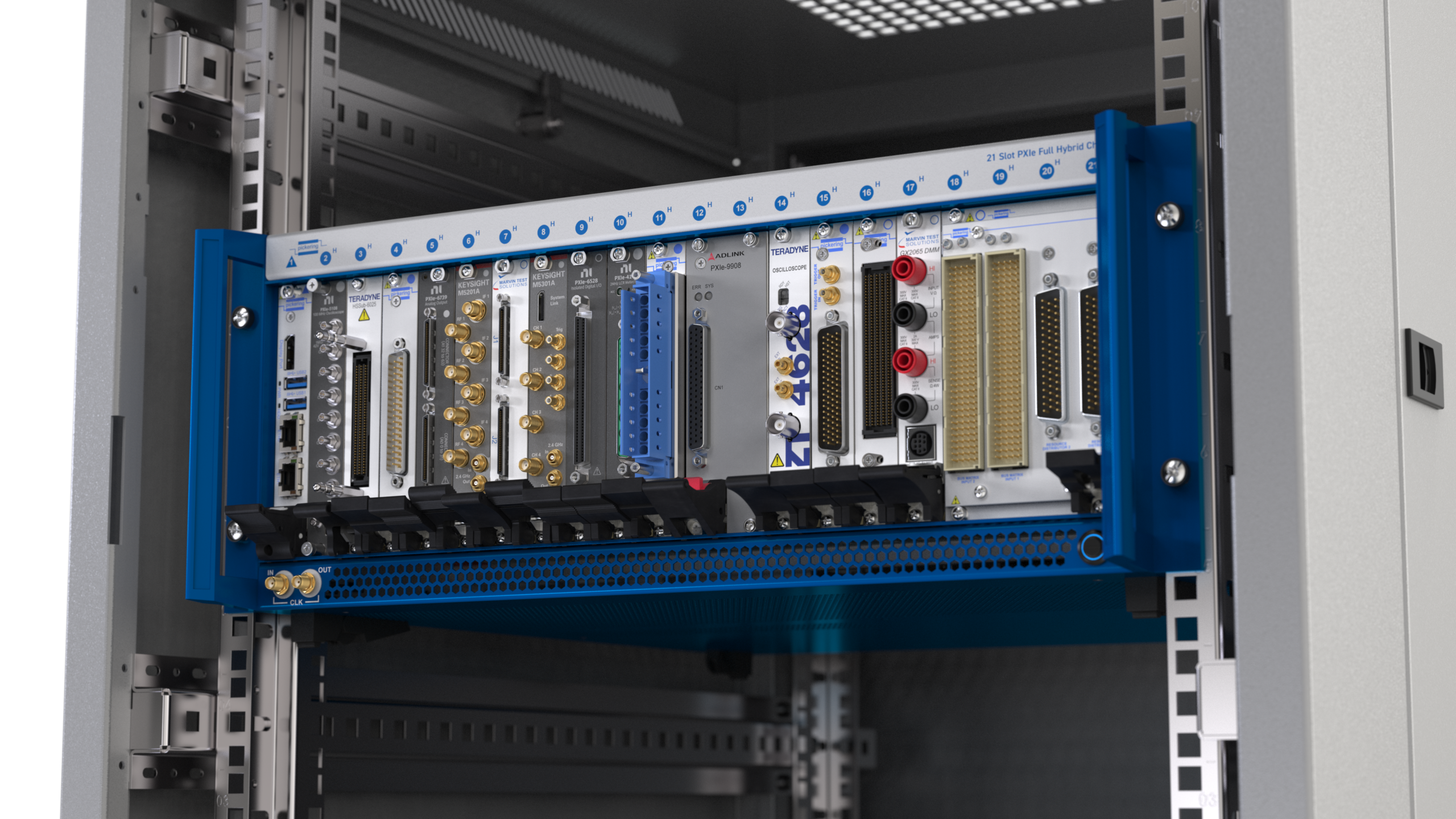
Mass Interconnect

Connect PXI to the DUT — quickly, reliably and repeatedly.

A PXI system can contain hundreds or even thousands of measurement, stimulus, switching and control connections. Wiring each signal individually to the device under test (DUT) may be workable during early development, but it becomes difficult to reproduce, maintain and reconfigure as a test program grows.

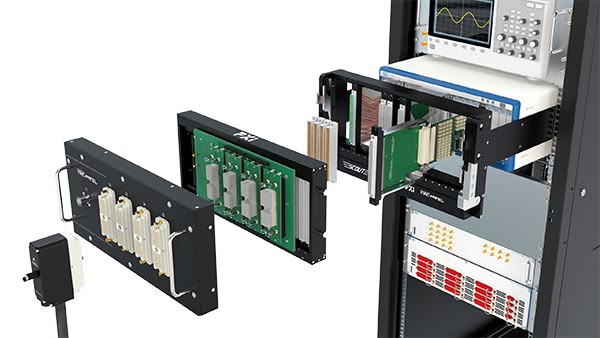
A mass interconnect creates a defined mechanical and electrical interface between the test system and the DUT. Instead of connecting every cable separately, an operator mates the system-side receiver with an interchangeable test adapter (ITA) in a single action. The result is a cleaner, repeatable connection that protects instrument connectors and makes it easier to use a common PXI system with different products or fixtures.
Where mass interconnect adds value

Faster changeover

Exchange an ITA or fixture to move between DUTs without rebuilding the instrument-side wiring.

Greater repeatability

Create a consistent connection across operators, stations and repeated test cycles.

Easier maintenance

Organise complex wiring around known connection points that are simpler to document, inspect and troubleshoot.

Better lifecycle economics

Protect instrument connectors, simplify station replication and reduce rework over the life of the test system.

How the connection comes together

Receiver — the system side

The receiver mounts to the rack or PXI chassis and brings signals from PXI instruments, switching and other system resources to one common interface.

ITA — the interchangeable side

The interchangeable test adapter mates with the receiver and routes only the signals needed for a particular DUT or product family.

Fixture or cable — the DUT side

A fixture, connector assembly or cable completes the path to the DUT and provides the mechanical alignment, ergonomics and repeatability required by the application.

PXI instruments connected through a mass interconnect receiver and interchangeable test adapter to a device under test.
A mass interconnect creates a reusable system-side interface, while interchangeable adapters and fixtures connect the PXI system to different DUTs.

Plan the connection before building the fixture

The best interconnect approach depends on signal count and type, electrical performance, instrument selection, fixture needs, expected changeovers and the required service life of the system. NI’s guide explains the receiver, ITA and fixture architecture, then walks through the key design choices.

PXI is the core. System integration delivers the solution.

The chassis, controller and modules provide the computing, timing and instrumentation platform. The surrounding infrastructure connects that platform to the DUT, makes it safe and serviceable, and turns test requirements into an automated process.

The Components Around PXI

What completes a PXI-based automated test system?

Every system is different, but most production, validation and hardware-in-the-loop systems combine PXI with several of the following elements.

Rack, mechanics and thermal management

The enclosure supports and protects the system while providing equipment mounting, cable access, airflow, cooling and practical service access. Its size and layout must account for the DUT, fixture, operator and future expansion — not only the PXI chassis.

Power, loads and auxiliary hardware

The DUT may require programmable AC or DC power, electronic loads, battery simulation, signal conditioning, pneumatics or specialised non-PXI instruments. Power entry, distribution, grounding, sequencing and backup power must be designed as one coordinated system.

Safety and compliance

Emergency power-off, interlocks, circuit protection, isolation, guarding, thermal protection and safe discharge can be as important as the measurements themselves. The design must address operator safety, DUT hazards and the regulations that apply to the deployment environment.

Signal path, mass interconnect and fixturing

Cables, switching, connectors, signal conditioning, the receiver, ITA and DUT fixture form a single measurement path. Their bandwidth, voltage, current, shielding, guarding and maintenance requirements must support the performance of the PXI instruments behind them.

Test software and operator experience

Software configures instruments, controls the sequence, applies limits, handles errors and records results. It may also provide an operator interface, user access control, calibration workflows and links to databases, manufacturing systems or laboratory infrastructure.

Data, deployment and lifecycle support

A production-ready system needs version control, configuration management, documentation, diagnostics, calibration planning, spares and a strategy for updates. These disciplines make it possible to reproduce stations and support them throughout a long programme lifecycle.

System Integration

Bring every part together as one bespoke solution

A PXI system can be assembled by an experienced in-house test team. For organisations without that capacity — or for programs with demanding schedules, safety requirements, unusual DUT interfaces or multiple deployments — a systems integrator can take responsibility for the complete solution.

The integrator starts with the test requirements and develops the architecture around them: selecting compatible hardware, designing the rack and signal path, creating fixtures, developing the software, building and wiring the station, and verifying that the complete system performs as intended. The result is not simply a collection of products, but a documented and supportable test capability tailored to the application.

What a systems integrator can deliver

  • Test strategy, requirements capture and system architecture
  • PXI and complementary instrument selection
  • Rack layout, power distribution, thermal design and safety engineering
  • Mass interconnect, cabling, fixtures and DUT handling
  • Test sequencing, instrument control, operator interfaces and data integration
  • System assembly, verification, documentation and acceptance testing
  • Installation, training, replication and long-term support

Find PXI expertise for your application

PXISA member companies span PXI hardware, software, connectivity and system integration. Explore the member directory to find organisations that can help define your architecture, supply key elements or direct you to an experienced integration partner.