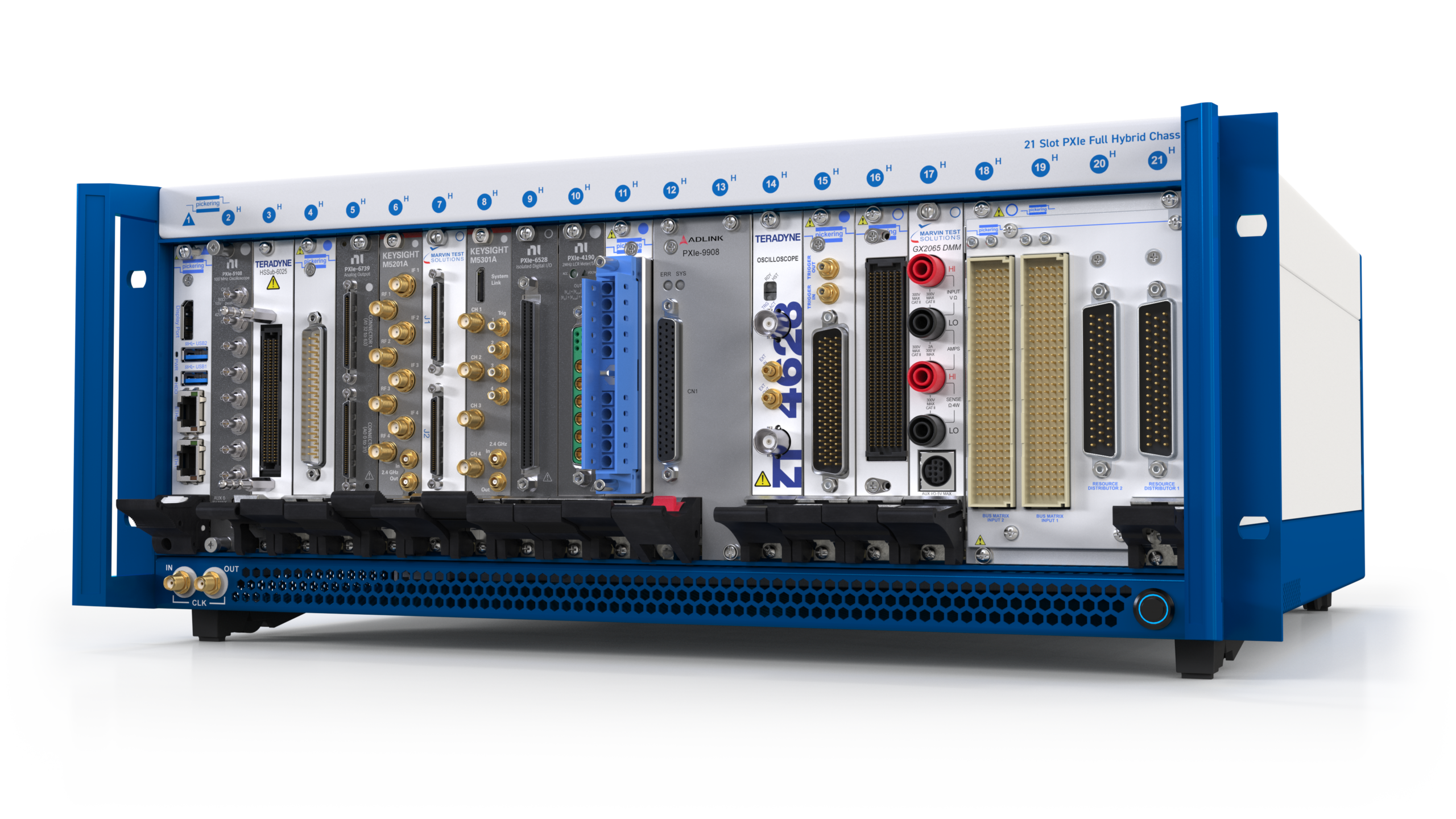
PXI combines modular instrumentation, high-speed data movement, precision timing, software-defined control, and a broad multi-vendor ecosystem within a single standard. That makes it ideal for testing today’s complex electronic systems.
Home
/
Why PXI
Why PXI
PXI is the de facto standard for automated test
Compared with traditional rack-and-stack box instruments, PXI reduces cabling, improves synchronization, increases test density, and makes automation easier.
Overview
Built for testing today’s complex systems
Capabilities
What makes PXI powerful
01
Tight synchronization
Built-in timing and triggering synchronize instruments without complex external cabling
02
Smaller Size
High-density modular instruments reduce rack space and simplify system design, without sacrificing accuracy
03
Software-defined
Software is at the core of a PXI System. It configures hardware, executes test sequences, processes data, and monitors system performance
04
Long-term Scalability
Reusable modules with long lifecycles scale across products, stations, and sites
05
High-speed Data Movement
Increase throughput with high-speed data transfer between modules and systems
06
A Complete Ecosystem
A thriving market of interoperable instruments, switching, software, interconnects, and services
Comparison
PXI: A Better Approach
Box instruments are excellent tools. They are familiar, powerful, and often ideal for benchtop debugging, interactive measurements, and smaller test setups. But box instruments are usually optimized as individual instruments, even when connected together over communication standards such as LXI.
PXI is optimized for automated test.
Performance
Box: High accuracy. Slower throughput due to message-based communication.
PXI: High accuracy and speeds. DC to RF.
Breadth of instrumentation
Box: Enormous number of options in all shapes and sizes.
PXI: Multi-vendor open standard. Very large number of instrument options.
Synchronization
Box: Possible through LXI and external cabling.
PXI: Built-in backplane triggers and reference clocks.
Footprint
Box: Large.
PXI: Compact.
Channel density
Box: Low, at a system level.
PXI: High, across many instrument types.
Software automation
Box: Possible, but optimized for manual operation.
PXI: Core design principle.
Reuse across programs
Box: Possible, but major rework often required.
PXI: Modules, software, and architecture can be readily reused.
Cost
Total Cost of Ownership
The purchase price of instruments is only part of the cost of a test system.
The bigger costs often appear later: integration time, cabling, debugging, downtime, manual setup, inconsistent configurations, duplicated software, difficult replication, poor reuse, and slow adaptation when requirements change.
PXI helps reduce these hidden costs by giving test engineers a standard for system design. A well-architected PXI system can shorten development time, improve repeatability, reduce rack space, simplify synchronization, and make it easier to deploy similar systems across teams and sites.
That is why PXI is often chosen not just for performance, but for long-term test strategy.
Strategy
From one test station to a test strategy
PXI helps test departments move from isolated test setups to a common automated test platform. That platform can support design validation, production test, regression systems, repair and depot test stations, and future product generations.
What PXI enables
- For test engineers, PXI reduces friction.
- For test managers, PXI improves reuse and standardization.
- For manufacturers, PXI supports throughput, repeatability, and deployment at scale.
- For organizations, PXI turns test from a cost center into a strategic advantage.
Build
Build with the PXI ecosystem
PXI is an open standard supported by companies across the automated test industry. PXISA members provide the hardware, software, interconnect, services, and expertise needed to build complete test systems.
Whether you are validating a new design, modernizing a production line, or creating a platform for future products, PXI gives you a proven foundation for automated test.
Members
Explore PXISA member companies
The companies that build, integrate, and ship PXI systems worldwide.
View members →Reading
The NI PXI eBook
A deep-dive introduction to PXI and modular test.
Read the eBook →Reading
PXImate by Pickering
Pickering’s practical PXI guide for test engineers.
Read PXImate →Products
Find PXI products by category
Browse chassis, controllers, instrument modules, switching, and interconnects.
View products →