Overview

A standard for modern automated test

Modern electronics are more complex, more connected, and more software-defined than ever. Testing them often requires multiple instruments working together: measuring analog signals, sourcing power, switching hundreds or thousands of test points, generating RF signals, capturing digital data, simulating sensors, or controlling a device under test.

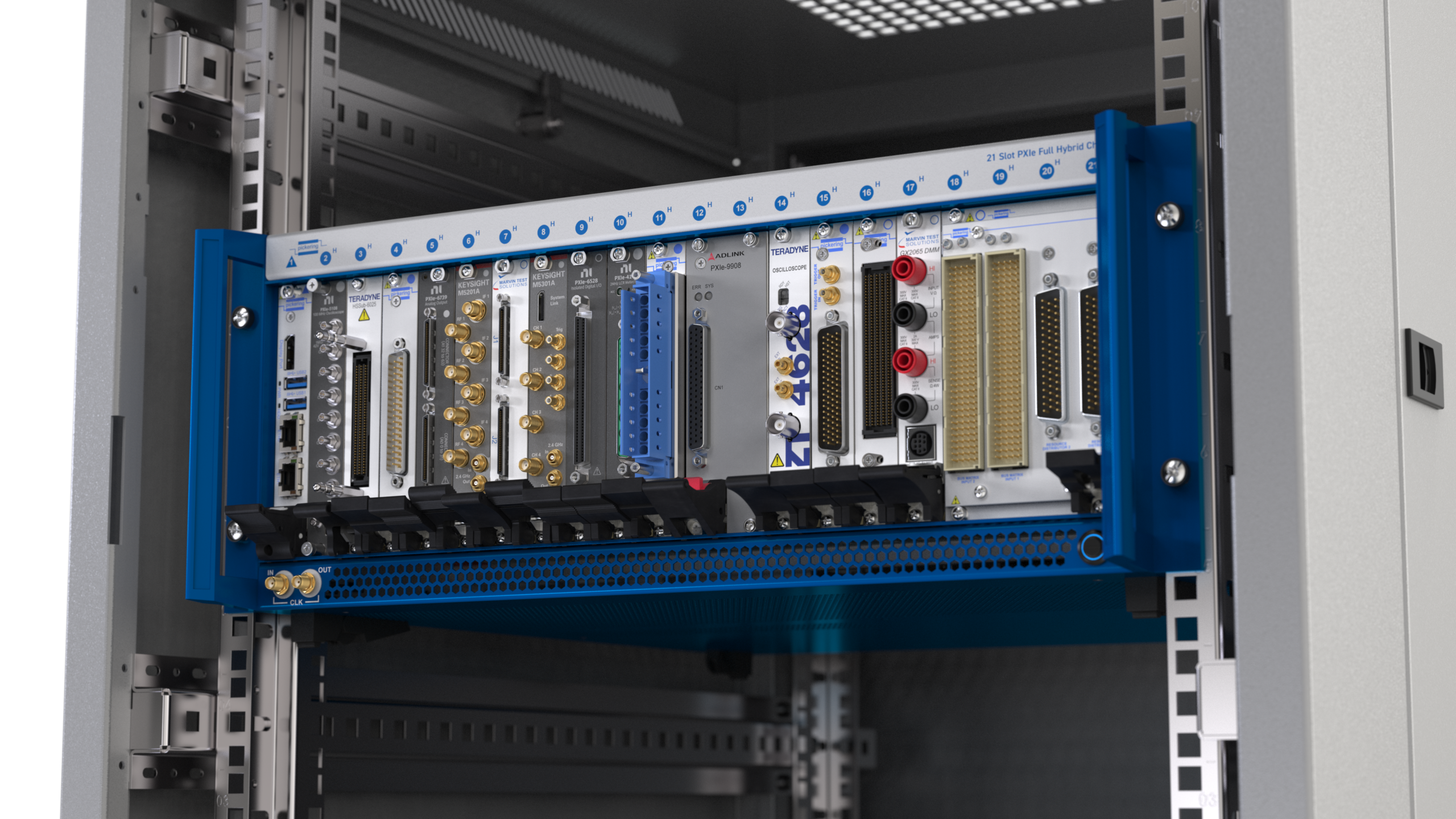
PXI was created for this kind of challenge. Instead of assembling a rack full of stand-alone instruments, a PXI system brings instruments together inside a single modular chassis with shared power, cooling, timing, triggering, and high-speed data movement.

PXI systems are commonly used across the product lifecycle:

Research and design validation

Engineers use PXI to prototype measurements, characterize devices, debug failures, and validate designs across many signal types, from DC to light.

Automated production test

Manufacturers use PXI to build repeatable, high-throughput functional test stations that can be deployed across lines, factories, and regions.

Hardware-in-the-loop and simulation

PXI is widely used to simulate sensors, loads, communications, faults, and real-world environments to test the software inside embedded controllers and electronic systems.

Data acquisition and monitoring

PXI provides synchronized, high-channel-count acquisition for applications that require fast, accurate, and repeatable measurements.

System components

What makes up a PXI system?

A PXI system is built from a small number of core building blocks: chassis, controller, modules, software, and system completion components. The exact configuration depends on the test application.

FIG. 02 — LAYERED VIEW
01 — Application layer
Test Executive TestStand / ATEasy Custom Test Software MATLAB / Python LabVIEW
02 — Instrument drivers
IVI · VISA · PXI Software Specifications Vendor-neutral API
03 — PXI chassis & backplane
01
CONTROLLER
02
DIGITIZER
03
AWG
04
SOURCE
05
VNA
06
SWITCH
07
DMM
PXI BACKPLANE · PCIe Gen 3 · TIMING & SYNC 10 MHz REF · TRIG[0:7] · STAR
04 — Device under test
DUT — Wafer · PCB · RF Module · EV Battery · Aerospace System Validation · Production
1. Chassis and backplane

The PXI chassis is the physical and electrical foundation of the system. It houses the controller and instrument modules, supplies power and cooling, and connects everything through a high-performance backplane.

The backplane is what makes PXI more than a card cage. It provides the communication bus, timing, triggering, synchronization, and slot-to-slot connectivity that allow multiple instruments to operate as one coordinated test system.

PXI is based on mainstream PC bus technologies, including PCI and PCI Express, combined with rugged Compact PCI-style mechanical packaging and test-specific timing and synchronization features.

2. Controller

The controller is the computer that runs the test system. It may be embedded directly in the PXI chassis or connected remotely from an external PC.

A PXI controller typically runs the operating system, test executive, instrument drivers, measurement software, data logging, user interface, and automation code. To the software, a PXI system behaves like an extension of the computer’s own PCI or PCI Express bus.

3. PXI and PXI Express modules

PXI modules are the instruments and I/O that perform the actual test functions. Depending on the application, a system may include:

  • Digital multimeters
  • Oscilloscopes and digitizers
  • Arbitrary waveform generators
  • Signal generators and analyzers
  • Vector signal transceivers
  • Source measure units
  • Programmable power supplies
  • Digital I/O
  • Data acquisition
  • Fault insertion
  • Sensor simulation
  • Switching, multiplexing, and matrix modules
  • Timing and synchronization modules
  • Communication interfaces

Because PXI is modular, engineers can configure a system around the signals they need today and expand or modify it as requirements change.

4. Software

PXI is a software-defined instrumentation standard. Instead of relying on knobs, displays, and front panels for every instrument, PXI systems are controlled through software.

That software may include instrument drivers, configuration tools such as soft front panels, test executives for sequences, application software such as data loggers, database connectivity, user interfaces, and custom code written in environments such as LabVIEW, C#, .NET, or Python.

5. System completion

A working PXI test system is more than a chassis and modules. PXI systems often include:

  • A cabinets with power and safety electornics
  • Mass interconnect
  • Cable assemblies
  • Fixturing
  • Load boards
  • Calibration and asset management

PXISA member companies provide not only instruments, but also the supporting technologies and services needed to turn PXI into complete automated test systems.

The PXI standard

PXI stands for: PCI eXtensions for Instrumentation.

The PXI standard defines the mechanical, electrical, and software requirements that allow compliant products to work together. It builds on proven PC and industrial computing technologies, then adds the features test engineers need: timing, triggering, synchronization, rugged packaging, cooling, software discovery, and multi-vendor interoperability.

The PXI Systems Alliance promotes the PXI standard, ensures interoperability, and maintains the PXI specification. Because PXI is an open specification, multiple vendors can provide products that work well together within the same test system. This gives engineers choice: they can select the best chassis, controller, instrument, switching, software, interconnect, or integration partner for the job.

History

A short history of PXI

PXI was developed in the late 1990s to solve a practical engineering problem: how to make modular instruments communicate, synchronize, and operate together more effectively than traditional rack-and-stack test systems.

National Instruments developed and announced the PXI specification in 1997 as an open industry specification. PXI launched commercially in 1998, and the PXI Systems Alliance was formed to promote the standard, maintain the specification, and support interoperability across vendors.

Since then, PXI has evolved from the original PCI-based architecture to PXI Express, adding higher bandwidth, improved synchronization, greater power and cooling capability, and continued compatibility options for long-lived test systems.

Today, PXI is used by thousands of companies and research centers around the world to build automated test systems that need to last, scale, and adapt.

Ecosystem

Why the ecosystem matters

PXI is not a single-vendor product line. It is a standard and an ecosystem.

That ecosystem includes companies that make chassis, controllers, instruments, switching, RF and microwave modules, power products, communication interfaces, simulation modules, cables, connectors, mass interconnect, software, services, and complete test systems.

For engineers, that means flexibility. A PXI system can combine products from different suppliers while preserving a common architecture. That helps organizations standardize where it matters and differentiate where the application requires something special.

The published specification

The published specification family.

PXI is defined by a family of public specifications maintained by the Alliance working groups — spanning the hardware backplane (PXI-1, PXI-5), the software architecture (PXI-2, IVI), MultiComputing, and compliance procedures. Each is free to download and revised as the standard evolves.

PXI-1 PXI-2 PXI-5 PXI-9 IVI
Learn more

Ready to learn more?

Explore PXI through resources from PXISA member companies.